
Ripening into Honey

Bees do have a smell, you know … for their feet are dusted with spices from a million flowers.
— Ray Bradbury1
July has arrived with her Southern sultry self. The wineberries are plump, the mullein is blooming, the evening primroses are doing their bright yellow thing, the bottle brush bush is beginning to burst, and the turkeys come a’calling for seed (including a mama who brought her half dozen chirruping babies to the door). A large black bear visits our compost and leaves his big, beautiful, musky scent all over the nighttime air. The bucks huff in the woods and two mother deer have three gamboling fawns between them (pure joy medicine). The blue-tailed skinks skitter around the deck and a fat raccoon can be seen ambling in the distance from time to time. Early morning birdsong is joined by the voices of millions of pollinators … the soundscape is one big Hallelujah! as far as the ear can hear.


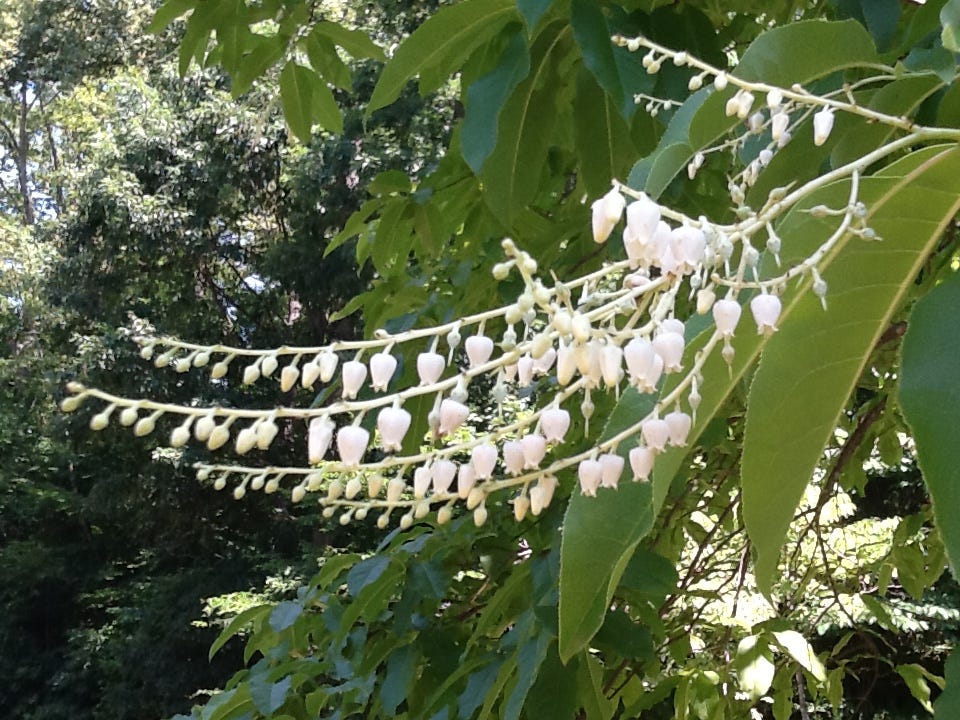
The summer honey flow2 is full on and the honeybees are up early, seeking the abundant nectar from the Sourwood trees with their drooping clusters of white, bell-shaped flowers (like fistfuls of lilies of the valley, upside down). I stand under these singing trees that are thick with bees for about a month, immersed in sacred bee time and the divinity of plants, the land, the bees, and every living thing. It is a holy-rolling moment and I am bedazzled.
I started writing a poem about four years ago, celebrating this luscious bee-ish season, and was inspired to finish it today, to share with you. Some things to know before I do …
The daily pilgrimage of a honeybee from home to bloom (to bloom) is responsible for two of the most divine substances on earth … honey and wax. The sacred alchemy of flower nectar become honey become wax begins when a honeybee lands on a flower. To harvest the nectar, a bee extends her long, hairy, retractable tongue which unfurls from her head and acts as a straw. How she has space in her head for such a thing, astonishes me. The honeybee sucks up the nectar into her stomach and then retracts her tongue when she is done. Honeybees have two stomachs: one for the food which meets their own body’s needs and another expandable pouch called a honey stomach which is used to carry nectar (and sometimes water) back to the hive. A bee visits flower after flower until her honey stomach is full and then she returns home.
During this odyssey, the holy transmutation of nectar into honey has already begun. As the bee moves amongst the flowers, the nectar stored in her honey stomach moves around, mixing with enzymes which start to change and break down the sugars. Upon her return to the hive, a transfer takes place between the foraging bees and the house bees. The forager (or field bee) extends her tongue and moves the nectar from her honey stomach into the mouth of a receiving bee. Eventually the nectar ends up in a cell of honeycomb where it is “dried” by house bees flapping their wings 200 – 300 times a second to bring the moisture content down. It is then capped (with wax) and stored as food for the colony, both for the present and the coming-along winter. The scientific word for this nectar exchange is called trophallaxis. But the bee-enchanted … the poets … call this a Honey Kiss.
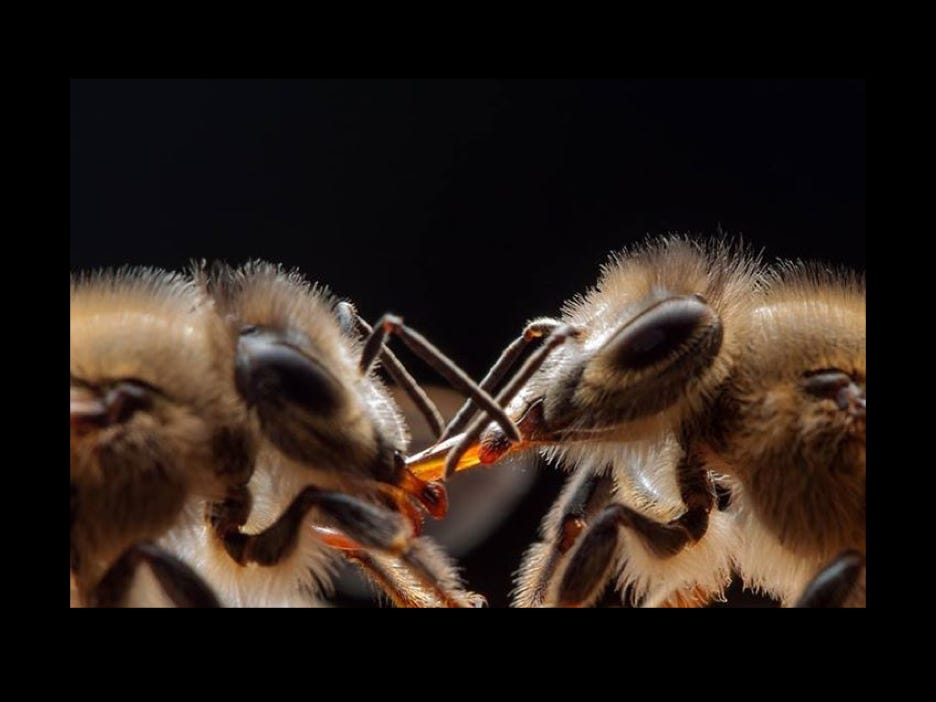
This sacred cooperation is such a reflection of rightness and all-is-wellness in their world. The precious intimacy of this exchange, this holy bee communion, is a visible sign of grace that stirs a very tender and devotional place in me.
One of the other bee-consecrated substances is wax, whose aroma is one of my most favorite (right up there with the scent of fresh bread, mock orange flowers and barnyards). I have sometimes slept with fresh wax wrapped in fabric and tucked under my pillow. Its fragrance is Medicine and stirs a sense of belonging with an ancestral bee lineage that for me is as strong as with my biological family And everywhere in this story, the divine feminine is strongly at play. Right now, the bees are surging toward their mid-summer peak of 60,000-ish beings per colony. The queen is the only fertile female. She lays the eggs and can beget as many as nineteen generations of bees in the warm-weathered months in our region. Worker bees, who comprise most of her companions and the majority of the hive, are also female but infertile. Their life’s work is another sort of miraculous.
Historically, young worker bees are often called virgins … but the wonderful Jacqueline Freeman calls them maidens, which I think is lovely. Between twelve to eighteen days old, the maidens have special wax producing glands on the underside of their abdomens. In order for their bodies to do this, they need to gorge on honey. Doing the bee math, a group of maidens needs to consume about six to eight pounds of honey to produce one pound of beeswax. Serious holy business. As they consume it, the wax scales they extrude from their glands is collected by bees, chewed, and applied to create honeycomb … the brilliantly efficient, hexagonal cells which store honey and pollen and also host generations of new bees.
Atsilvsgi is a Cherokee word Grandmother Red Leaf taught me which means flower or blossom. It also means: Where Creator lives. Isn’t that wonderful? Bees and blooms have been courting each other for millions of years. Theirs is one of the oldest love stories in creation and Creator is everywhere in evidence amongst them. Both their honey and wax have been the stuff of cherished ceremonies, rituals, blessings, libations, prayers and healing across many cultures and even more centuries. And so, this poem of celebration …
Epic and sacred
is nectar
become honey
become wax
become light
the holy journey
of fragrant ambrosia
from millions and millions
of generous flowers
ferried with care
in the tiny chalice
of a foraging bee
alchemically transmuted
kissed into the hive
gorged by young virgins
whose bodies extrude
the beeswaxy bones
for hive, hearth, and home
hallowed temple
for generations of bees
to flourish, to thrive
to bless and to dream
aromatic membrane
that carries vibrations
and cherished messages,
love letters, prayers
perfume of blossoms
perfume of pollen
perfume of honeycomb
revered Melissaes3
we take your sacrament
bowing down, reverent
knowing
that we
have been blessed.
blessed be
blessed bees
When I am in my bee sanctuary surrounded by the fragrant yeasty smells of pollen and new wax … the shivering vibration of millions of tiny-winged beings going about their business … and the many songs of the colonies … I always recalibrate and feel more present and alive. This experience inclines towards the divinatory; I sometimes feel a charged-up wisdom that courses through my veins and wants to express itself in my life in some sacred fashion. So many bee people I know, and especially women, feel a deep resonance with this pulsing field of unified consciousness and intelligence that naturally accompanies a colony of bees. When we are around them as appreciative witnesses, without any agenda, then the holy blueprint of us has the capacity to re-remember itself back into wholeness. This is no small thing. We ripen into honey and co-exist in a divine field of life where ultimately there is no bee and there is no human. Just loving presence … which the honeybees remind us is the only thing that is ever really going on. For that, and so much more, I give thanks.
Blessed be. Blessed bees. And blessed you, dear Holy Mischievians. Happy ripening.
❤️ Debra
From Ray Bradbury’s novel, Dandelion Wine.
A honey flow (also called a nectar flow) is a seasonal peak period in a year when nectar-producing plants bloom in abundance and honeybees harvest massive surpluses of nectar to convert into honey (food for the hive for the entire year). Depending on where you live, the seasons of honey flow vary. In North Carolina, we have two: a spring and summer flow.
Melissaes: The root word comes from the ancient Greek word mélissa, meaning honeybee or honey.
Ahh I give thanks for this holy visitation with the honeybees. I am at their tiny holy feet that smell like flowers. And the summer blessings of your place land in my body through your words. Whereas I feel defeated by the heat here, the nuances you share light up my mind, thank you. Right now I am looking at my altar where some honey from your bees you shared with me many moons ago, a little piece of honeycomb from Osman's hive, and a ball of propolis lay at the feet of the Black Madonna statue you recently gifted me. I keep their medicine close to my heart. My world expanded ever since I started getting to know the honeybees and other pollinators through your loving heart. I am grateful.
Dear Debra. I shall listen to this post again and again, until it gets to the middle of me, the heart of the heart, passed the dead ends and the broken mirrors. The sound of your voice and words convey the raw, yet refine wisdom of bees. Of love. It’s been at least five years since I did tend a hive. And I now live in a small apartment downtown Sherbrooke scarce in pollen and nectar. Yet! A swarm still lives in a secret cavity of my heart. It does so for twenty years. Twenty years the first time I smell the spicy aroma of a full bloom hive and it’s high vibrancy. Twenty years since I fell in love with them and that loved changed me forever. Often my attention gets caught into other territories, far from bee land and my own heart. But when the momentum is ripe, a breach opens up and I stumble on hive wisdom that inevitably brings me back to the soil of my immanence. You, Debra, embody that joy, wisdom and beauty of the sacredness of the Hive. I, Jessica am part of that golden circle even if I often forget. With all the other Mellissae.
Few weeks ago, I started the lecture of the Cantique des cantiques, The Song of songs translated by Jean-Yves Leloup which surprisingly dwells into the bible. It is a text about the wisdom of love. I feel a strong connection between this text and Persian poetry of the medieval period. Maybe Filiz knows about it? That holy text is a metaphor between two lovers. It is about the frémissement (I do not know an adequate word in English) that takes place within the inner room of the heart when love is awakened. In my inner gaze, le frémissement amoureux and bee vibrancy emit the same soft and warm light.
The last two years had their load of thick darkness, but even in the belly of fear and confusion, the frémissement has never completely fade. The path is not easy but how beautiful when the gaze knows where to dwells. Thank you Debra for being here and now with us. Thank you for being alive and granting us your mischievous wisdom! Much love!